OpenAI just gave its AI agents a wallet. Here is how a supply chain guy turned AI consultant would decide what an AI gets to buy, and what it never touches.
By Warren Schuitema, AI Systems Consultant, Matchless Marketing / Matchless AI
Last Updated: November 2026

Last week, OpenAI started handing its AI agents a way to pay for things.
It is called ChatGPT Wallet. It started rolling out on November 13 to a limited group of ChatGPT Pro subscribers in the United States. The agent finds the item, fills the cart, and walks up to the checkout. Then it stops and waits for you to say yes with Face ID or a fingerprint.
So should you let it buy things for your family or your business?
My short answer: yes, for small, boring, repeat purchases you already understand. Only with your approval on every single one. And never for anything you could not undo with one phone call to your card company. Right now, that approval step is built in. Every purchase still needs your thumb or your face. Keep it that way, even after OpenAI lets you loosen it.
I spent 16 years in manufacturing and supply chain. In that world, nobody hands a new buyer the company card on day one. You earn spending power in small steps, with limits, with receipts, and with somebody checking the math. I think an AI agent deserves the exact same treatment. Same ladder. Same limits. Same receipts.
That is what this post is about. What ChatGPT Wallet actually does, what the numbers say about trust, and a simple way to decide what your AI gets to buy.
Key Takeaways
- ChatGPT Wallet lets OpenAI's always-on agents, called "dots," complete purchases, but every purchase still needs your Face ID or fingerprint approval.
- Most people are not ready yet. Forrester found only 24% of US online adults trust AI agents to make routine purchases for them.
- Some companies are pushing back. United Airlines now restricts third-party AI agents from booking flights or touching MileagePlus accounts.
- The safest way to use an AI buyer is the way factories train human buyers: small limits first, known vendors only, and a receipt you check.
- Use this test before you let any AI spend: does it give you back Time, Money, or Energy, without costing you control?
OpenAI Just Gave Its Agents a Wallet
Here is what we know, pulled from the launch coverage.
ChatGPT Wallet works inside conversations with a "dot." Dots are OpenAI's always-on agents. OpenAI introduced them in late September. Each one has its own cloud computer and browser, so it can go do tasks on the web while you do something else.
Wallet is how a dot pays. Per Digital Commerce 360 and Dataconomy, it launched with American Express, Mastercard, and Visa. It is for adults 18 and older with an eligible US-issued credit card. Debit cards are not supported. Neither are virtual cards, at least at launch.
The checkout piece is the part I like. The agent never sees your real card number. Neither does the store. The card network creates a one-time token for that single purchase. You review the items, the total, and the card. Then you approve with Face ID or a fingerprint. Each approval leaves a purchase record.
Purchases run through the store's normal checkout. The store still handles pricing, shipping, returns, and customer service. If an item shows up broken, you keep your normal card protections for eligible disputes. OpenAI says it does not hold your money or act like a bank.
One more thing matters a lot. Later on, OpenAI plans to let people pre-approve purchases with limits on spending, product type, or time period. No date has been given for that.
So today, it is a helper that shops and then taps you on the shoulder. Down the road, it could become a buyer that spends on its own inside rules you set.
That second version is the one to think hard about now, before it shows up.
Most People Are Still Holding On to the Card
If letting an AI spend your money makes your stomach flip a little, you have plenty of company.
Forrester surveyed US online adults in March 2025. Only 24% said they trust AI agents to act on their behalf to make routine purchases. That is about one in four. And that was for routine stuff. Not a new laptop. Not a vendor contract. Just the boring reorders.
I get it. Money is where trust gets real.
When an AI writes a bad email draft, you delete it. When an AI buys the wrong thing, you are on hold with customer service on a Tuesday night while the kids need a bath.
And the risk is bigger than a wrong size. Scams are big business right now. The FTC says Americans reported losing a record $15.9 billion to fraud in 2025. Anything that touches your card becomes a target. Fake stores. Fake deals. Fake "your order failed, click here" messages. An AI agent that shops for you is one more door. The token setup in Wallet helps a lot, because the agent and the store never hold your real card number. But a safe payment does not fix a bad decision about what to buy, or who to buy it from.
So the worry is fair. The question is whether worry should be your whole plan.
The Stores Are Nervous Too
Shoppers are cautious. So are some of the big companies they buy from.
On November 11, United Airlines said it is restricting third-party AI agents. Per Skift, that covers United's own website and app, plus access through travel sites and aggregators. United is the first US airline to say so out loud.
United's reasons are worth reading, because they apply to your kitchen table too. Sharing your login with an outside agent can expose private information. An agent could make a purchase you did not mean to make, change your booking, or burn your miles. Some steps in air travel also need a real person to agree to them, like confirming what is in your bag.
United says it will look at the policy again as personal AI assistants grow up.
Here is my take. When a giant company with a huge legal team decides an agent should not touch customer accounts yet, that is a signal. Slow down. Set your rules before the agent shows up at your door.
Expect more of this. Some stores will welcome AI buyers with open arms. Some will block them. Your agent will hit walls. Plan for it.
Why Would a Busy Parent Even Want This?
Fair question. If it is risky, why bother?
Because the time is real.
Heartland Forward and Echelon Insights surveyed 691 small business owners in September 2026. 43% said they currently use AI. Among the owners who use it, 93% said it saves them time. More than half said they save five or more hours a week. And 81% said AI lets them do more with the same staff.
Five hours a week. For a parent running a business from the spare bedroom, that is bedtime stories. That is a soccer game you actually watch.
A quick note on that survey, so you can judge it yourself. It was an online survey, not a random sample, weighted to match Census numbers for small businesses. The release came out as a paid press release. I still think it is useful. Just hold the numbers loosely.
Buying stuff is a quiet time sink. Think about the reorders. Printer ink. Shipping labels. Coffee pods for the office. Diapers. The same groceries every week. Each one is five minutes. Five minutes, twenty times a month, adds up fast.
So yes, there is a real prize here. The trick is grabbing the prize without handing over the keys.
A Good Buyer Earns Spending Power in Steps
This is where my 16 years in manufacturing and supply chain come in.
On a plant floor, purchasing runs on rules. A new buyer does not walk in Monday and get a company card with no limit. Spending power comes in steps.
First, there is an approved vendor list. You buy from people the company already checked out.
Second, there are dollar limits. Small buys go through. Bigger buys need a manager's signature.
Third, there is the match. In a lot of shops, accounting checks three papers before paying: the purchase order, the receiving record, and the invoice. Did we order it? Did it show up? Is the bill right? If those three do not line up, nobody gets paid.
All of that exists for one reason. Mistakes get caught early, while they are still cheap.
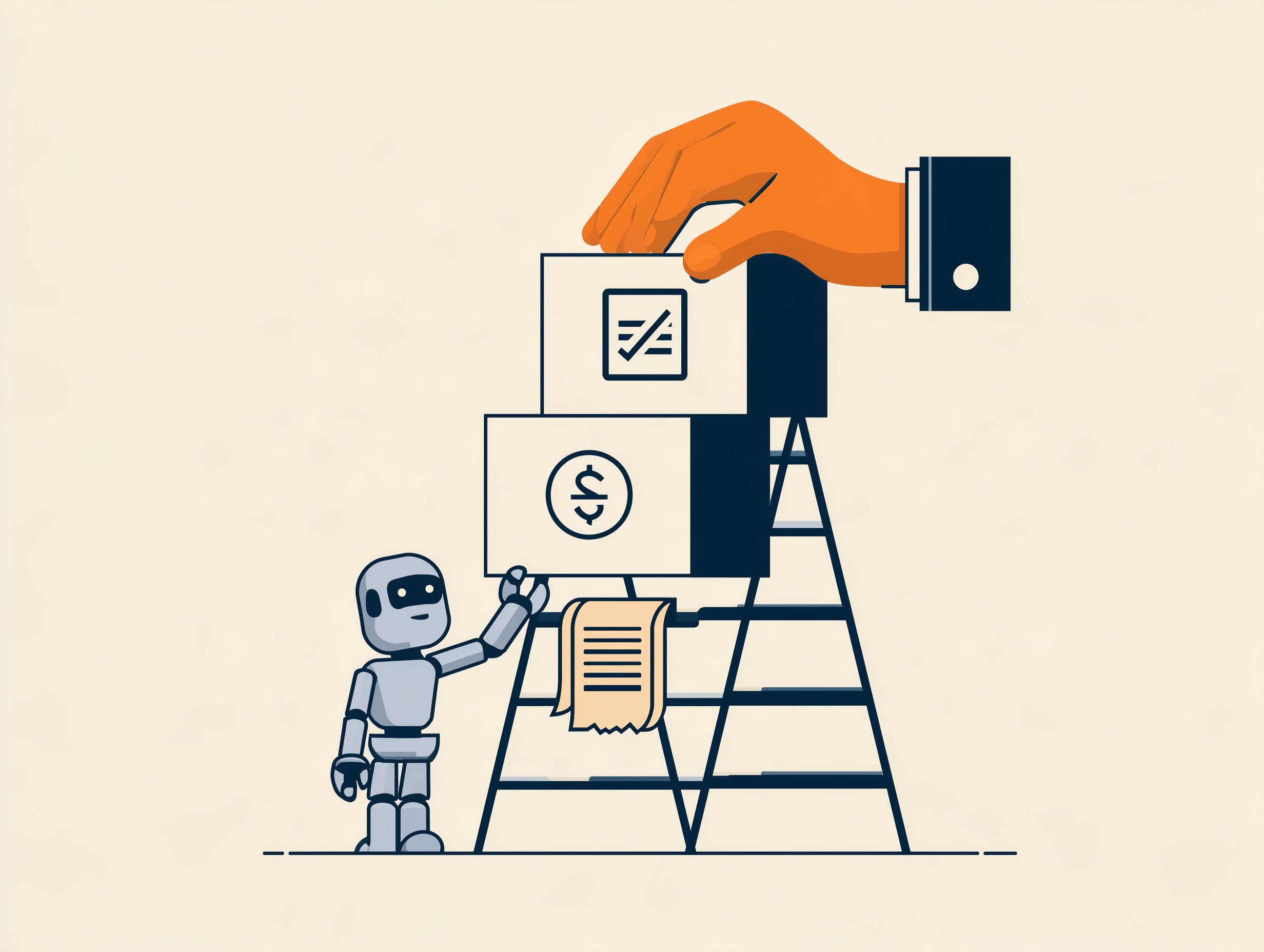
So here is my reframe. Treat your AI agent like a new hire in purchasing. Give it the same ladder you would give a person. Small limits first. More room as it proves itself.
I call it the Purchase Order Test. Before an AI buys anything for you, ask three questions:
- Is it on the list? Would you be fine buying this exact item, from this exact store, without thinking about it?
- Is it under the line? Is the price below a number you picked ahead of time, when you were calm and not in a hurry?
- Can you check it later? Will you get a clear receipt you will actually look at, and can you undo the purchase if it is wrong?
Three yeses? Let the agent shop it, and you approve it. Any no? You buy it yourself, the old way.
That is the whole thing. No tech degree needed. Just the same common sense a good plant manager uses every day.
And notice what it leaves out on purpose: how smart the AI is. Clear rules matter more than clever answers.
Here Is Where I Draw the Line at Home and at Work
I run my business with a team of AI agents. They draft my emails, prep my morning brief, plan my content, and track who I owe a follow-up. They work while I am with my two girls in the morning.
But one rule sits over every single agent. Nothing sends, posts, books, bills, or spends without my word. Every agent drafts. I approve. That rule is the reason I can let them work at all.
So I like that ChatGPT Wallet starts the same way. Approval on every purchase is the best feature in the whole launch.
Now let me show you how I think about it with two systems I actually built.
The Weekly Meal Planner. I built an AI meal planner for our family. It replaced HelloFresh for us, and it ended what I call the Sunday planning spiral. You know the one. Staring at the fridge. Scrolling recipes. Arguing about tacos again.
The planner gives me the plan and the list. That is the part that used to eat my Sunday.
Would I let an agent take that list and fill a grocery cart? Under the Purchase Order Test, groceries pass pretty easily. Same store. Same items most weeks. A total I can predict within a few dollars. A receipt I will look at, because I am the one unpacking the bags. That is a fine place to start, with my thumb on the approve button.
The Digital Wall Calendar. We built a digital wall calendar for the family. It replaced a $50 a month subscription. It also ended the nightly "who is driving who where tomorrow" conversation.
That $50 a month is the lesson. Subscriptions are where money quietly leaks. They are small. They renew on their own. Nobody checks them.
So here is a hard line for me. An agent can help me find a subscription. It can compare two of them. It does not get to sign me up for one. A recurring charge fails the Purchase Order Test on question three, because it keeps billing long after anyone is checking.
Same goes for anything big, anything new, or anything from a store I have never heard of. Those I buy myself.
That is the Time, Money, Energy test in action. Groceries through an agent? Saves time, costs about the same, saves energy. Yes. A new software plan picked by an agent? Might save time today, but it could cost money every month for a year. No.
Seven Steps Before You Let Any AI Spend a Dollar
Here is how to set this up, whether you use ChatGPT Wallet or any other AI shopping tool.
- Write your "always fine" list. Open a note on your phone. List 10 things you buy over and over without thinking. Ink, labels, coffee, paper towels, the same groceries. This is your approved list. If an item is not on it, the agent does not buy it.
- Pick your line, and pick it while you are calm. Choose one dollar amount. Maybe $50. Maybe $100. Anything over that, you buy yourself. Write it at the top of the note. Deciding ahead of time beats deciding at 10 PM when you are tired.
- Use one card for agent purchases. If your setup allows it, keep agent shopping on one credit card with a low limit. Not the card that pays payroll. Not the card tied to your business taxes. One card. One place to check.
- Keep the approval step on. Wallet asks for Face ID or a fingerprint on every purchase today. When the option to skip it shows up, leave it off for at least 90 days. Watch how the agent does first. Trust gets earned.
- Check the three-way match once a week. Pick a time, like Friday afternoon. Look at what you approved, what showed up, and what got charged. Do the three match? If not, call your card company that day. Fifteen minutes, once a week.
- Never give an agent your passwords. United's worry is real. Do not hand your login for your bank, your airline, or your business tools to any outside agent. Use the payment setup the platform gives you, where the card number stays hidden.
- Run the Time, Money, Energy test every month. Ask yourself: did the agent shopping save me time? Did it cost me more or less money? Did it give me energy back, or add worry? If it did not give you something back, stop using it. No guilt.
Start with step one tonight. It takes five minutes, and it makes every other step easier.
Frequently Asked Questions
What is ChatGPT Wallet?
ChatGPT Wallet is OpenAI's payment feature for its always-on AI agents, called dots. It lets an agent complete a purchase at a store's normal checkout. You still review the items and total, then approve each purchase with Face ID or a fingerprint. It began rolling out November 13, 2026.
Who can use ChatGPT Wallet right now?
At launch, it is rolling out to a limited number of ChatGPT Pro subscribers in the United States. Users must be 18 or older and have an eligible US-issued credit card. Debit cards and virtual cards are not supported at launch. Even eligible Pro users may not see it yet.
Is it safe to let an AI agent use my credit card?
It is safer than handing over your card number. With ChatGPT Wallet, the card network creates a one-time token, so neither the agent nor the store sees your real number. You keep your card's normal dispute protections. The bigger risk is a bad buying decision, so keep approvals on and set limits.
Should a small business use AI agents for purchases?
Yes, for small, repeat purchases from stores you already trust. Start with supplies you reorder often, keep a dollar limit, and approve every purchase yourself. Avoid using agents for subscriptions, big purchases, or new vendors. Treat the agent like a new buyer who earns more spending power over time.
Can an AI agent buy things without my approval?
Not with ChatGPT Wallet today. Every purchase needs your Face ID or fingerprint approval. OpenAI says it plans to let users pre-approve purchases inside limits on spending, product type, or time period later, but has not given a date. When that arrives, turn it on slowly, if at all.
A Better Way to Hand Over the Wallet
Go back to that moment at checkout. The agent has filled the cart. The total is on the screen. It is waiting for your thumb.
That pause is the most important part of the whole product. Protect it.
AI agents that shop for us are coming whether we are ready or not. Some stores will welcome them. Some will slam the door. The tools will get faster and the approval step will get easier to skip. That is exactly when your rules matter most.
You do not need to be a tech person to handle this well. You need what every good purchasing department already has. A list. A limit. A receipt you actually read.
Give your AI the same ladder you would give a new hire. Let it prove itself on the coffee pods before it ever sees the big stuff. And keep asking the only question that counts: is this giving me back Time, Money, or Energy?
If it is, great. Let it carry the grocery list.
If it is not, close the cart and go hug your kids.
Because the best AI system in your house is the one that frees up your hands, while you keep your hand on the wallet.
That is A Better Way.
AI agents acting for customers now also call businesses to book, not only buy online, so the same approval rule matters on the phone too. Read What Should Your Small Business Do When Google's Gemini AI Calls to Book?
Before an AI agent buys or books anything, it reads what customers say about the business, so reviews shape what AI recommends. For more on that, see Do Online Reviews Still Matter When Customers Shop With AI?
Keep Learning
- Should You Let AI Read Your Bank Account? The other half of this question: what to think about when AI can see your money as well as spend it.
- How Do You Keep AI Usage Charges From Surprising Your Small Business? Simple ways to keep AI bills from creeping up on you.
- Is Your AI Assistant Quietly Making Your Business Decisions for You? How to keep the final call in your hands as AI tools get more helpful.
- Should You Claim Your Business Profile in ChatGPT? The seller side of AI shopping: making sure ChatGPT gets your business right.
About the Author
Warren Schuitema is an AI Systems Consultant with Matchless Marketing and Matchless AI. Before AI, he spent 16 years in manufacturing and supply chain, where purchasing controls, vendor lists, and receipts were part of every day. Today he runs his own business with a team of AI agents built on one rule: nothing spends without his word. He builds practical AI systems for small business owners and parent entrepreneurs, from a Weekly Meal Planner that replaced HelloFresh to a Digital Wall Calendar that replaced a $50 a month subscription. His test for every system is simple. Does it give back Time, Money, or Energy? Learn more at matchless-marketing.com.