Running a household and a business at the same time is a logistics problem. AI agents are finally good enough to solve it.

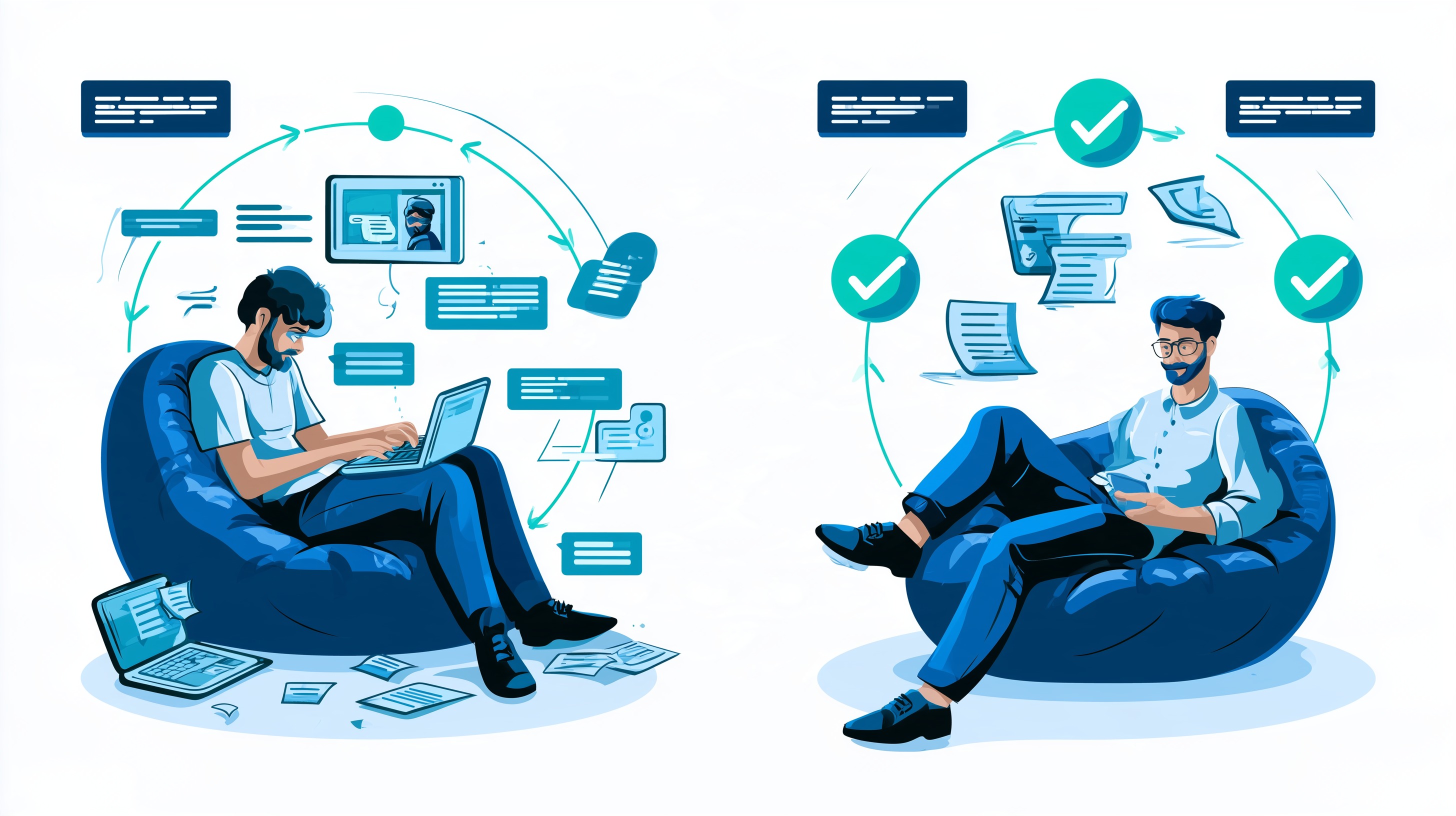
The difference between a chatbot and an AI agent is simple. A chatbot waits for you to ask it something. An agent goes and does the thing.
That gap matters more than most people realize. For the last three years, AI tools have made you smarter and faster at tasks. They answered questions, wrote drafts, helped you think. But you still had to do the work. The agent wave changes that. Now AI can be handed a job, go complete it, and report back.
Google proved this in September 2026 when they launched CC, an experimental household AI agent. CC doesn't just answer questions about your family's schedule. It manages shared calendars, fills out permission slips, creates meal plans, and sends your family a "Your Day Ahead" brief every morning. Six family members can share one agent. One less hat to wear.
The answer to the title question is direct: AI agents can handle the tasks that drain you every week without adding anything back onto your plate.
Key Takeaways
- AI agents take action without needing you to supervise them. Chatbots only respond when you ask.
- A 2024 LSE/Protiviti study found AI users recover an average of 7.5 hours per week -- a full workday.
- Google CC, launched September 2026, is the first major AI agent built specifically for household coordination.
- Parent entrepreneurs can deploy agents for meal planning, content creation, client follow-up, and scheduling right now.
- The best entry point: identify one task you hate doing every week and hand it to an agent first.
Why Most AI Tools Haven't Actually Freed Up Your Time
Most small business owners tried AI in 2024 or 2025. They signed up for ChatGPT, maybe Claude or Gemini. They used it for a few weeks. Then they realized something: they were still the operator. They had to log in, paste the context, write the prompt, review the output, format it, and post it. AI cut the task in half. But they were still doing half a task, times fifteen different tasks, every single week.
That is not a better way. That is a slightly more efficient version of the same grind.
The people wearing all the hats -- running a business, raising kids, keeping a household -- don't need more tools that require constant attention. They need systems that run without supervision. The shift from chatbot to agent is the shift from tool to system.
What the Research Actually Shows About AI Agents and Time Recovery
The LSE and Protiviti published a study tracking AI productivity for knowledge workers. Workers using AI tools consistently recovered 7.5 hours per week. That is one full workday returned to you. SAP's own research tracked it down to 52 minutes per day across email, scheduling, and information retrieval tasks.
Writing tasks dropped by 69% in time when AI was used. Troubleshooting time fell by 76%. Programming work dropped by 74%. These aren't projections. These are measured outcomes from researchers watching real workers do real tasks with AI assistance.
Google's CC launch is the proof point that major technology companies see households as the next target for agents. The CC agent connects to Gmail, Google Calendar, and Google Docs. It creates a morning brief for everyone in the house. It fills out permission slips automatically when forms show up in the shared inbox. It builds a weekly meal plan and shopping list. One agent, shared across up to six people, handling the logistics that used to fall on whoever cared most.
That is usually you.
And adoption is accelerating fast. As of 2025, 78% of executives use AI tools in their work, up from 51% in 2023. Companies reporting $3.70 return per $1 invested in AI are the ones who moved from chatbots to agents first. (Source: Stealthagents.com Executive Productivity Research 2026)
The Shift That Changes Everything: Tools Require Attention. Systems Run Without It.
Here is the tip most AI coaches miss. A hammer is a tool. A conveyor belt is a system. Every time you open a chatbot and type a prompt, you are using a tool. When you build an agent that handles your weekly meal planning, your Monday morning client email sequence, or your social media repurposing, you have built a system. You built it once. It runs every week. You get that time back every single week from that point forward.
I spent 16 years in manufacturing and supply chain before I started Matchless AI. The first thing they teach you in that world: a process you have to touch every day is a process you haven't finished building. That lesson applies directly to AI. If you are still manually prompting the same tasks every week, you have not finished the build.
The test I apply to every tool I build is simple. Does this give back Time, Money, or Energy? If it does, I know I found a better way. The Weekly Meal Planner I built for my own family replaced HelloFresh, killed the 45-minute grocery planning spiral every Sunday, and now runs automatically. That passed the test. My Digital Wall Calendar eliminated a $50/month subscription and the fifteen-minute nightly "what are we doing tomorrow?" conversation. That passed too. Both are agent-based systems, not tools I have to use.
How Parent Entrepreneurs Are Deploying AI Agents Right Now
You don't need a technical background to start using agents. The shift is already underway: every recurring task in your life is a candidate for one of three agent builds. A household agent handles the family logistics. A business content agent handles your writing, repurposing, and publishing. A client operations agent handles follow-up, summaries, and routine communication. Google CC is already a working household agent. For business content and client operations, tools like n8n, Claude, and Zapier are the building blocks. You connect them, give them context, and hand them the task.
The parent entrepreneurs who get the most out of this do one thing first: they pick one task. Not five. Not a full workflow overhaul. One task. They build the agent for that task, watch it work, and add the next one after that.
One of the highest-leverage tasks to hand off is the phone itself: AI phone agents answer every inbound call, book appointments, and route the urgent ones straight to you — business coverage that keeps running while you're covering your family.
6 Steps to Start Running Your Week on AI Agents
Step 1: List your recurring weekly drains.
Open a blank document and list every task you complete on a consistent schedule that does not require your unique personal judgment. Meal planning, grocery lists, social post drafts, newsletter summaries, inbox sorting, appointment reminders -- all of these are agent candidates. Write every one of them down.
Step 2: Pick one and find the right existing tool.
Take your top candidate and search for an existing agent-based tool before you build anything. Google CC covers household logistics. Buffer or Zapier with Claude covers content creation and publishing. Notion AI covers summarization and documentation. You do not have to build from scratch if a tool already exists and does the job.
Step 3: Set up Google CC for your household first.
Go to Google Labs and sign up for the CC experiment. It is currently free for up to six adults with personal Google accounts in the US. Add family members, set sharing preferences for your calendar and specific email senders, and let CC run for two full weeks before you evaluate it. The morning brief alone is worth the fifteen-minute setup.
Step 4: Audit one business task for automation.
Take a recurring business task and map every step in it. If you write a weekly newsletter, map: topic selection, research pull, outline, draft, edit, format, publish. Every step that does not require your personal story or judgment is a step an agent can handle. Build around those steps.
Step 5: Use n8n or Zapier to connect your tools.
These two platforms are the connective tissue for agents. They let AI tools talk to each other: your email, your calendar, your CRM, your social channels. A basic Zapier account is free. An n8n setup can be self-hosted for full control. Either one can automate 80% of what you currently do manually every week.
Step 6: Set a 30-day review and measure the time you get back.
After one month, look at your calendar and your energy levels. If you got three hours back and your Sunday afternoons are less stressful, the system is working. Add another task to the agent stack. The goal is not to automate everything in 30 days. The goal is to build one system a month until your week runs with significantly less friction.
Frequently Asked Questions
What is the difference between an AI chatbot and an AI agent?
A chatbot responds to your questions when you ask them. An AI agent takes action on your behalf without requiring a manual prompt every time. You give an agent a goal, and it completes steps, checks external sources, and reports back without you supervising each move. Chatbots are reactive. Agents are proactive.
Is Google CC free to use?
As of September 2026, CC is a free Google Labs experiment available to adults with personal Google accounts in the United States. Up to six people can share one household agent. It connects to Gmail, Google Calendar, Google Docs, and Google Chat. Availability may expand beyond the current experiment period.
Do I need to know how to code to build AI agents?
No. Tools like Zapier, n8n's visual editor, and Claude Projects allow non-technical users to build automated workflows without writing code. The setup requires time and clear thinking about your process, not programming skills. If you can map a task step by step on paper, you can build an agent for it.
How long does it take to set up a useful AI agent?
A simple agent for a single recurring task -- like auto-drafting a weekly email summary or generating a meal plan -- takes two to four hours to set up for the first time. More complex multi-step workflows can take a weekend. The time invested is typically recovered within the first two weeks of the agent running consistently.
What should a parent entrepreneur automate first?
Start with the task you hate most that repeats every week. Common first wins include: weekly meal planning, grocery list generation, social post drafts from existing content, appointment reminder emails, and weekly business metric summaries. These have clear inputs and clear outputs, which makes them the easiest agents to build and test.
The Dad Who Built the Tools Is Telling You to Start With One
I started building my own AI systems in early 2024 because I was tired of being the bottleneck in my own household. I built the Weekly Meal Planner because HelloFresh stopped being cost-effective and I was still spending 45 minutes every Sunday figuring out food for the week. I built the Digital Wall Calendar because nobody was updating the physical board and we were missing events. I built OutQuest because I was watching my kids choose screens over outdoors and I wanted to change the dynamic without turning it into a fight.
None of those builds required a development team. They required a clear problem, time to map the solution, and patience to get the agent running correctly.
That is the real story behind this agent wave. It is not magic. It is engineering applied to the same problems families and business owners have always had. The tools just got accessible enough for the rest of us to use them.
You do not have to automate your whole life this month. Pick one task. Build one agent. Watch what happens to your Sunday afternoons.
That is a better way.
Keep Learning
- What If AI Was Your Home Manager First, and Your Business Tool Second? — The companion piece to this one. Why automating home logistics first makes your business performance sharper. Start here if you haven't read it.
- Is Your Sunday Night Planning Ritual Still Taking 3 Hours? Here's the AI System That Fixes That — A 20-minute AI-powered weekly reset that covers your business and your family in one Sunday session.
- AI Models Are About to Get a Lot Cheaper to Run. Here's What That Means for Your Business. — Why falling inference costs make agent systems affordable for small business owners right now.
- Do AI Agents Actually Handle Your Everyday Tasks — Or Is That Still Hype in 2026? — The 5 everyday tasks AI agents handle right now, with time savings quantified and the exact no-code setup.
About the Author
Warren Schuitema is the founder of Matchless Marketing and Matchless AI in Allegan, Michigan. He spent 16 years in manufacturing and supply chain systems before turning those same process-engineering instincts on small business operations and family life. He builds AI-powered tools for parent entrepreneurs who want to get their time back without hiring a full team. His builds include a weekly AI meal planner, a household digital calendar, and OutQuest, a screen-time alternative app built for families. He writes for parent entrepreneurs who are done wearing all the hats alone and are ready to build systems that run without them.